
Beyond the Leaf Blower Ban: What Happens When Leaves Stay Put?
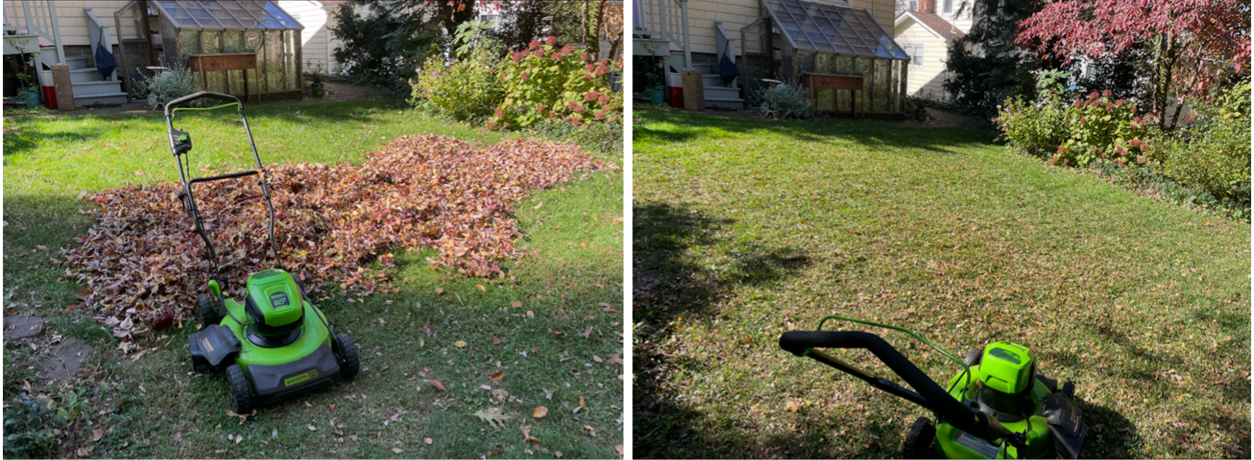
Images before (left) and after (right) of Pam and Chris Black’s yard demonstrate leaf mulching, a technique that chops fallen leaves into small pieces and redistributes them across the lawn instead of bagging or blowing them away. Photo by Chris Black.
By Sahana Lynch
South Orange officials are considering extending the current ban on the use of gas-powered leaf blowers,, a step similar to one taken by neighboring Maplewood, and in alignment with New Jersey's larger goal of fully phasing out gas-powered blowers by 2027.
Gas-powered leaf blowers contribute to both environmental and public health issues. The gas engines emit 30% of their fuel as pollution, releasing harmful particulate matter, carbon monoxide, and smoke, according to Sustainable Woodstock.
Gas-powered leaf blowers can also exceed 100 decibels, double the sound level in a typical household, according to NJ.com. According to the Centers for Disease Control, just two hours of 85-decibel exposure or above can cause permanent hearing damage.
Landscapers often unknowingly face excessive exposure to both the emissions and noise, said Erika Papaccioli, a South Orange resident and a member of her local Citizens Climate Lobby chapter.
"It's one thing that it's bad for the environment, but it becomes more of an issue for the landscapers," Papaccioli said.
South Orange's current ordinance prohibits gas-powered leaf blowers from May 1 to Sept. 30, while electric blowers are allowed Monday through Friday from 8 a.m. to 6 p.m. and weekends from 10 a.m. to 4 p.m.
Papaccioli mentions that costs for gas blowers are also significantly higher.
"They use gasoline, which is not cheap, and then they require you to do an oil change and tune-ups. The total maintenance costs for a gas-powered leaf blower could be up to $2,000 a year, while electric leaf blowers would only be $160 a year."
Maplewood banned gas-powered leaf blowers as of Jan. 1, 2023, due to community concerns about noise and environmental impacts. Montclair has banned gas-powered blowers, while Princeton allows them for several weeks in the spring and fall. A bill has been introduced to ban the sale and use of gas-powered blowers, but it remains in committee.
While the transition to electric-powered blowers can decrease noise and air pollution and lower costs, there may be another solution.
The Board of Education met on June 25 to continue its discussion of the proposal and invite residents to share their comments.
Pam and Chris Black, two South Orange residents who spoke at the meeting, explained that a largely ignored impact of both gas and electric blowers is their disruption of soil health and biodiversity. They highlighted that the harsh blowing strips topsoil and disturbs the insects that support a healthy ecosystem in the grass.
"The benefits of not blowing the soil, and with it the nutrients for bugs and things like that, are what I really appreciate about not using these blowers," Chris Black said.
Instead of removing leaves, the couple keeps the leaf litter on their lawn as a free, protective, nitrogen-rich mulch. They describe their process as simple, leaving the leaves as they fall, then mowing over the grass as usual with their electric lawn mower.
As the leaves break down, they return nutrients to the soil, and within days, the appearance of the leaves is completely minimized. Lawns receive more nutrients without fertilizers, and the habitat for insects and other organisms remains intact, all while avoiding the concerns of leaf blowers.
This leaf mulching practice also eliminates the need to collect, bag, and transport leaves to municipal composting facilities.
"The joke of it was, we would rake up all our leaves, stuff them in the bags, these guys would come, pick them up, take them to the dump a couple times in the winter, and then we would go back and pick all this stuff up in the form of compost and bring it back to our yards," Pam Black said.
Through its "Leave the Leaves" campaign, the National Wildlife Federation encourages homeowners to leave fallen leaves on their property, allowing them to decompose naturally into compost rather than being collected and removed. The organization notes that this approach can save homeowners time and money while reducing unnecessary emissions from leaf collection and disposal.
As South Orange considers extending current restrictions on gas-powered leaf blowers,, possibly phasing them out fully by 2027, the discussion has expanded beyond replacing one lawn tool for another.
For Chris Black, seeing his own lawn become healthier with a fraction of the effort was enough to change his perspective.
"Once you start to see the benefits in your own yard," he said, "I think you become more of a supporter."
Sahana Lynch is a senior at Columbia High School and a participant in CivicStory’s Summer Newsroom. A South Orange resident, she is excited to spotlight important civic and environmental issues and hopes to pursue environmental science in college and as a future career.