
How South Orange Residents Can Support Pollinators Through Their Backyards
By Mason Beaupierre
The most meaningful environmental changes often start quietly. They may not begin with a new law or a major conservation project, but rather with someone choosing to plant lavender instead of more grass. Or deciding to leave a few fallen leaves under a flower bed rather than blowing them away. These small choices may seem insignificant on their own, but together they can create something larger: habitat for the pollinators that keep local ecosystems healthy.
In northern New Jersey, pollinators play a critical role in maintaining healthy ecosystems. According to South Orange Environmental Commission Green Team expert Douglas Mullins, bees, butterflies, moths, beetles, and other insects transfer pollen between flowers, allowing many wild plants to reproduce. Those plants then provide food and shelter for birds, mammals, and countless other species that make up the region's natural environment.
According to Mullins, housing and commercial development have steadily replaced open space and native habitat, making suburban backyards an increasingly important refuge for pollinators.
In the garden of Vijya Campagne, an Orange resident, those small choices are easy to see. As you walk through her yard, colorful flowers and fragrant herbs fill nearly every corner. Lavender grows alongside herbs like basil, oregano, sage, and mint, while flowering plants add bursts of color throughout the growing season. It's a peaceful backyard, but also a space where bees and butterflies find food in an increasingly developed landscape.
Although many of the plants in Campagne's garden are not native to New Jersey, she has increasingly focused on choosing flowers that attract pollinators while adopting more environmentally conscious gardening practices. While these plants provide valuable nectar for visiting bees and butterflies, they represent one step in supporting pollinators rather than a complete habitat.
Campagne didn't always garden with pollinators in mind. "When I first started gardening," she said, "I planted what I thought was pretty."
Over decades of gardening in both North Carolina and New Jersey, her view changed. As she tried different flowers and herbs, she noticed that some plants consistently attracted more bees and butterflies than others. Lavender quickly became her favorite plant.
"I have seen them hover over them and eventually settle on the flowers," she said. "They are easy to grow."
Over the years, she has also noticed a troubling change.
"I recall seeing more bees and butterflies in my earlier years of gardening," she said. "Sadly, I see fewer visiting my garden in the last few years. This year, I have seen the fewest pollinators."
Those observations changed how she gardens. Today, she chooses colorful, fragrant flowers that attract pollinators and avoids practices that could harm them. While many of her plants provide valuable nectar for visiting bees and butterflies, she sees her garden as an evolving effort to better support local wildlife. In her experience, lavender consistently attracts the most pollinators.
She also believes successful pollinator gardening starts with the right attitude.
"A beginner can take steps to make a garden more friendly to pollinators only if they have the right mindset," she wrote. For her, that means recognizing the importance of clean soil, air, and water while understanding that individual actions contribute to the health of the environment.
That philosophy influences every part of her garden. Instead of using chemicals, she recommends homemade or organic compost to improve soil health, pulling weeds by hand whenever possible, collecting rainwater to water plants, and using organic mulch instead of dyed varieties. Most importantly, she encourages gardeners to start by planting flowers that provide food for pollinators, believing that even small changes can inspire people to become more environmentally conscious.
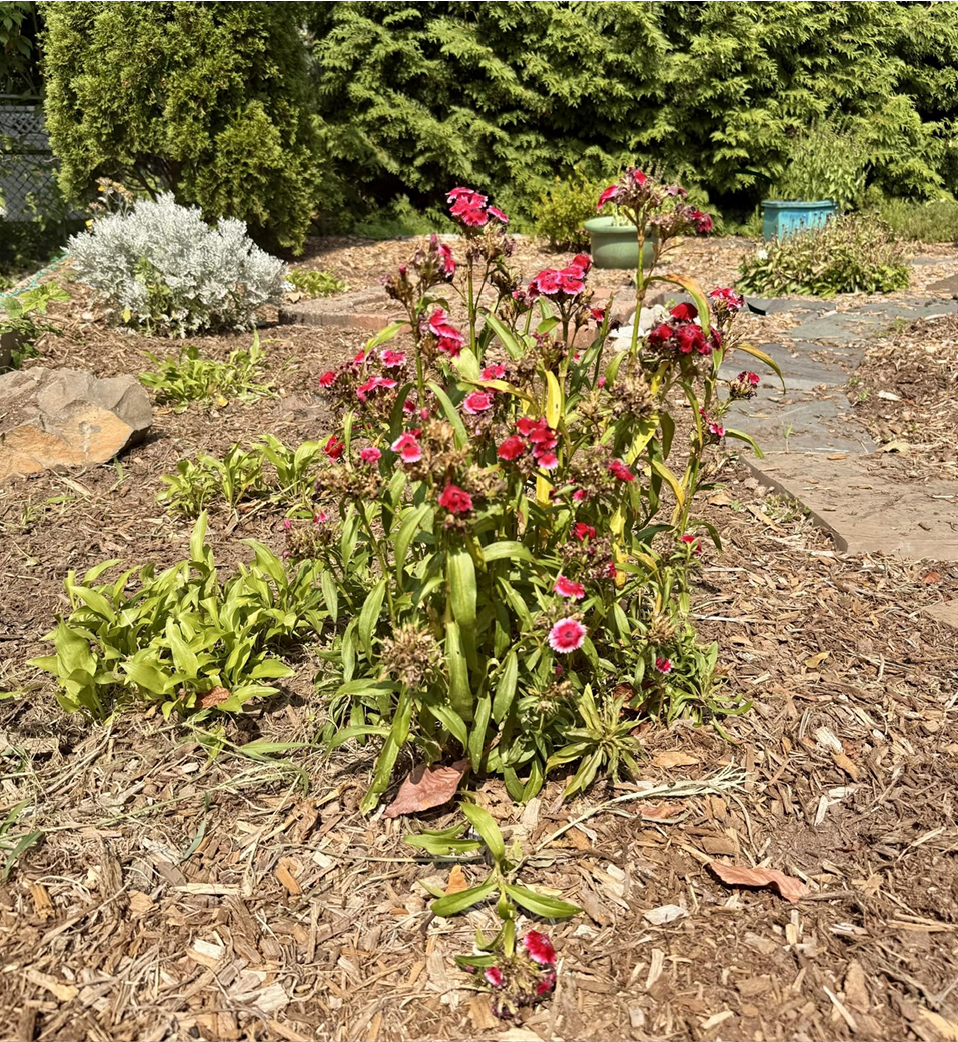
A colorful Sweet William plant blooms in Campagne's garden.
Campagne's garden illustrates one way homeowners can support pollinators by providing nectar-rich flowers. But Mullins says creating truly pollinator-friendly landscapes requires thinking beyond flowers alone.
"Insects are the foundation of the food web," Mullins explained. About 85% of wild plant species depend on insect pollination to reproduce. The fruits and seeds these plants produce become food for many birds and mammals in our communities. "You can draw a direct line between the insect pollinating a plant in your garden and the songbird in your tree."
Despite their importance, many pollinator populations are declining. Worldwide, insect species are decreasing by nearly one percent each year, Mullins said, with monarch butterflies and several bumblebee species experiencing significant declines. Habitat loss has become one of the greatest challenges facing pollinators, especially in suburban communities like South Orange.
For Mullins, reversing that trend starts with rethinking what a typical suburban yard should look like.
Driving through South Orange, it's common to see homes surrounded by neatly mowed lawns. While those lawns may look attractive, Mullins explained that they provide very little food or habitat for pollinators. Many homeowners also remove flowering plants like clover and dandelions and use herbicides to keep their lawns perfectly uniform, further reducing the resources available for insects.
When Mullins and his wife moved to South Orange, one of the first things they did was replace most of their front lawn with a flower garden filled with native plants. He admits the process has involved trial and error, but believes changing how people use their outdoor spaces is crucial for restoring local ecosystems.
Fortunately, creating a pollinator-friendly garden doesn't require tearing up an entire yard. A simple place to start is by planting native species. Mullins recommends native milkweed because it is the primary host plant for monarch butterflies, a flagship pollinator commonly known for its bright orange colors.
But nectar is only part of the picture. Mullins explained that many native insects lay their eggs only on specific native host plants, where caterpillars and larvae develop before becoming adults. While gardeners may see chewed leaves as a problem, he said those plants are actually functioning as nurseries that sustain future generations of pollinators.
Creating habitat also goes beyond planting flowers. Mullins pointed out that supporting pollinators means providing resources throughout their entire life cycle, not just nectar for adults. Native host plants allow butterflies and many other insects to lay eggs and raise caterpillars, while stems, leaf litter, and other natural materials provide nesting sites and winter shelter. Although gardeners may be tempted to remove damaged leaves or tidy every corner of the yard, these features are often essential habitat. He believes it's possible to maintain an attractive landscape while still supporting pollinators.
For homeowners who aren't ready to redesign their landscaping, Mullins offers an even simpler first step. Instead of mowing grass very short or removing every flowering "weed," he suggests letting lawns grow a little taller and allowing clover or dandelions to bloom when possible. Watching native bees gather pollen from those flowers, he says, can change how people think about the plants in their yards. Instead of seeing them as imperfections, residents can begin to view them as part of a larger network of life.
Mullins says that if more homeowners incorporate native plants alongside nectar-producing flowers, neighborhoods can begin functioning as connected habitats rather than isolated gardens to collectively provide the food and habitat pollinators need throughout their life cycle. Sometimes, supporting the environment begins with something as simple as planting a flower and giving a bee a place to land.
Mason Beaupierre is a rising senior at Columbia High School in South Orange, New Jersey, and a student reporter for CivicStory's Summer Newsroom. He enjoys reporting on local environmental and community issues. Outside of the classroom, he plays varsity soccer and tennis.