
Summit’s Green Showcase: 19 Local Organizations Prove Small Towns Can Lead Big Change
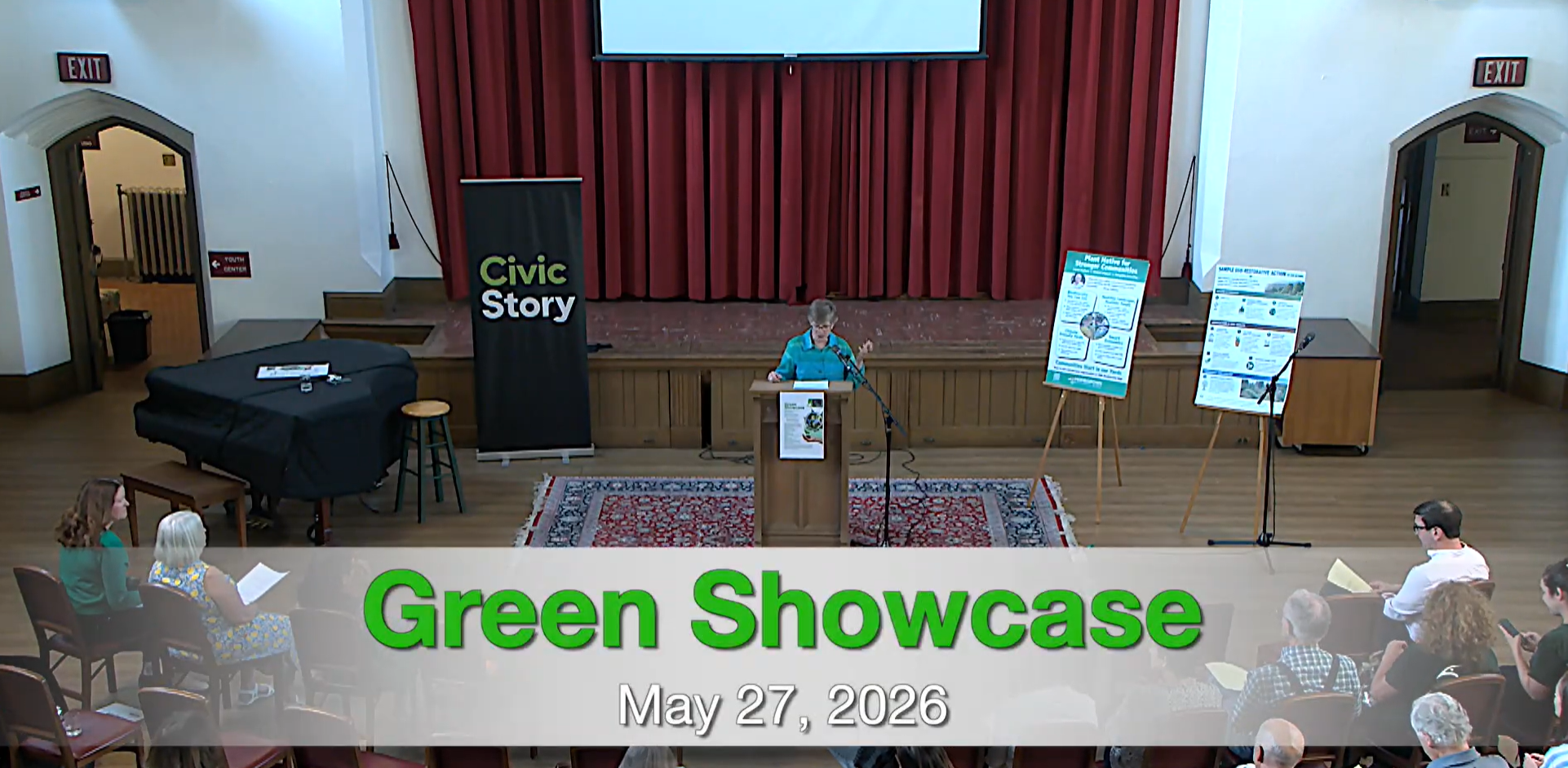
Susan Haig welcoming attendees to the Green Showcase. Photo courtesy of HTTV YouTube page.
Story by D'Arcy Perlman
On Wednesday, May 27, 19 local organizations gathered at Central Presbyterian Church for Summit's first Green Showcase. Co-presented by CivicStory and Central Presbyterian Church, it was a rapid-fire evening of ecological initiatives shaping life in Summit and the surrounding watershed. Missed it? Here's a rundown of who was there and how you can get involved.
Donna Goggin Patel, Summit Environmental Commission
Summit Environmental Commission is Summit's center for sustainability, with a team of volunteers relying entirely on grants and community support. Goggin Patel highlighted two of their major projects: an Earth Day Cleanup, which gathered 250 volunteers across 11 sites this spring, and their Tiny Forest, a Miyawaki-style native reforestation project with over 700 trees, shrubs, and wildflowers (curious about what a Miyawaki forest is? Check out this article on CivicStory to learn more). Keep an eye out for future Tiny Forest maintenance workdays and Tiny Forest Tours.
Mimi Zukoff, Summit Recycling Advisory Committee (RAC)
RAC works to remove materials from the waste stream and educate residents on recycling and reuse. Recent initiatives include updating the free Recycle Coach app (a re-download is recommended), releasing 10 Recycle Right videos on Facebook, Instagram, and the city website, and a campaign to opt out of unwanted plastic packaging on weekly Star Ledger deliveries. Their most urgent current message: all rechargeable and button batteries must be recycled, not trashed: they are classified as hazardous waste and pose a serious fire risk at transfer stations. RAC meets the first Thursday of each month (except July and August) at 4 pm on Zoom, and you can email summitDCS@cityofsummit.org for the link.
Christine Lijoi, Summit Free Market
The student-led initiative of Summit Free Market has grown into a permanent building at the Transfer Station where residents can donate and exchange quality goods. Open the second Saturday (8 am to 3 pm) and fourth Friday (12 pm to 2 pm) of every month, the market has diverted almost 200 tons of waste from the landfill. Contact pressoffice@cityofsummit.org for volunteer opportunities.
Terri Hutchinson, Summit Community Garden / ACHIEVE
The Summit ACHIEVE Community Garden is located at 99 Beauvoir Place and promotes local, organic food production with 56 raised beds, 12 of which are dedicated to growing for Summit's food pantries. The garden also maintains a pollinator bed and an on-site composting program using only garden-grown material. Spots fill up fast, so join the 2027 waitlist now to reserve your space!
Dr. Rob Rubino, Summit Park Line Foundation
The Summit Park Line is a 1.2 mile linear park along the abandoned Rahway Valley rail line connecting downtown Summit to Briant Park. The project prioritizes connecting East Summit, historically underserved for pedestrians and cyclists, to downtown, the train station, and recreational spaces. Recent milestones include building a new pedestrian bridge over Morris Avenue and the removal of two deteriorating train bridges over Ashwood and Russell Place, with plans to restore them by the end of 2026. Check out other upcoming improvements here.
Janette Spiezio, Sustainable Haus
Sustainable Haus is Summit's zero-waste refill store on Broad Street, with a mission to reduce plastic exposure for both environmental and personal health improvements. The store carries cleaning supplies, personal care products, home goods, food storage, and more and offers refill options at prices comparable to conventional products. Customers can bring any of their own clean, dry containers to fill. Spiezio and her team also handcraft over 100 of their own products, including soap, laundry detergent, and upcycled textiles. For further accessibility, Sustainable Haus is at the Summit Farmers Market every Sunday and ships across the US through their website.
Jackie Kondel, Reeves-Reed Arboretum
Reeves-Reed is Summit's largest green space, spanning 13.5 public acres. The Arboretum connects people of all ages to nature through education, holistic wellness, and the arts. A newly finished "Path for All" has created an accessible loop pathway through the gardens, and an ongoing woodland restoration project is hard at work with invasive species removal and native plantings. Find events and volunteer opportunities on their website.
Alison Eshak, Summit Green Schools
Summit Green Schools is a parent-led group working to empower students and families to live more sustainably. District-wide initiatives include a stuffed animal drive, a walk/bike/carpool competition, and book swaps numbering hundreds at each elementary school. Eshak discussed Earth in the Classroom, a curriculum for elementary schoolers on recycling, renewable energy, climate change, and plant physiology taught by parent volunteers.
Bill Glancy, Summit Area GreenFaith Circle
The Summit Area GreenFaith Circle is the oldest GreenFaith Circle in the country, uniting local religious backgrounds to advocate for environmental stewardship and justice. Their current major legislative push is the NJ Climate Superfund Act, also known as the "Polluters Pay" bill, which would require major fossil fuel companies to fund climate resilience infrastructure and natural disaster repair across New Jersey. More than 200 NJ clergy members have signed a letter in support, seven of them from Summit. Glancy emphasizes the importance of contacting your state senator or assembly member in support of this bill.
Paul Lemaire, Repair Café
"Throw it away? No way!" Repair Cafés bring volunteer repairers and community members together in public spaces for free, on-the-spot fixing of household items. Items repaired include bicycles, lamps, electronics, furniture, clothing, jewelry, dull knives, and watches. The philosophy is that it's not a drop-off, people stay, watch, and learn, building community in the process. The network has expanded widely, with the next event being held in Maplewood-South Orange on June 20. Find the full list of events, locations, and volunteer opportunities here.
Christina Amundson, Summit Garden Club
The Summit Garden Club encourages communal gardening, horticulture, and conservation. As a member of the Garden Club of America, Summit has access to conservation funding and national advocacy. The club helped create the Freeman Metal Collection of native plants at Reeves-Reed Arboretum, designed and maintained their herb garden, supported the Tiny Forest planting, and most recently reconstructed the US Post Office garden. On the policy front, their advocacy helped proclaim April as Native Plant Month in New Jersey and ban the sale of invasive plant species by state law.
John Kilby, Summit Shade Tree Advisory Committee
Summit's urban tree canopy, including ash, birch, and elm trees, has faced enormous pressure from disease and citizen removal. The city is making a large effort through replanting and a new ordinance on removals, but as about 60% of new tree placements are now resident-requested, individuals hold great power in addressing this issue. The committee also leads educational programming for Arbor Day and is exploring climate-resilient tree selection in collaboration with Reeves-Reed on climate-resilient tree selection.
Donna Goggin Patel (for Marin Mixon), Summit Farmers Market
The Summit Farmers Market runs every Sunday from 8 am to 1 pm, from April 19 through December 20 rain or shine, in the corner parking lot of Deforest Ave and Woodland Ave. They house nearly 70 vendors and a weekly gift table at the entrance that collects donations and home-grown produce for food pantry distribution. The market has grown increasingly sustainable over the years, with reusable bag encouragement and the reduction of vendor generators.
Irvy Pinzon, Together for Biodiversity
Together for Biodiversity links people and organizations through a shared love of the natural world. These initiatives include Christmas bird counts, cicada tracking for Biodiversity Day, and fostering youth participation and ecological literacy. Visit their biodiversity calendar to check out various upcoming local events and stay tuned for their AI Ecolab for environmental nonprofits to collaborate on utilizing this tool for project development.
Dwight Hiscano, Summit Conservancy
The Summit Conservancy is involved in most of Summit’s green infrastructure projects from building the Free Market at the Transfer Station, trail stewardship, the Tiny Forest, the bike depot, and now the Secret Garden at Summit High School for an immersive ecological education through produce production and supporting pollinator relationships. Click here to learn more about their work and get involved!
Amy Behr-Shields, Summit Free Public Library
Libraries are inherently sustainable institutions, but Summit's Free Public Library takes this one step further. Their Library of Things lets members borrow household items rather than buy new ones and a creative reuse pop-up on September 19th will invite the public to shop donated craft supplies for free. The Wilson White Learning Garden provides elementary students with hands-on farm-to-table growing exposure and the Native Seed Library stocked from the Tiny Forest provides native plant seeds for the community. Behr-Shields extended an open invitation to come visit anytime.
Lois Kraus, Beyond Plastics NJ
The New Jersey chapter of Beyond Plastics is co-chaired by Kraus and Sustainable Haus owner Janette Spiezio to take an interdisciplinary assessment of our society’s dependence on single-use plastic. They gather the first Monday of each month at Sustainable Haus and on Zoom. Their biggest recent win is the "Skip the Stuff" law, born from local ordinances in towns requiring restaurants to offer cutlery and condiments only on request, which will become a statewide mandate effective August 1, 2026, with a 180-day grace period for education and compliance. Kraus encouraged residents to help spread the word to local restaurants. Kraus recommends checking out the Netflix documentary The Plastic Detox to kickstart an understanding of the pervasive presence of plastic in our environment and ourselves.
Kirk Barrett, Rahway River Watershed Association (RRWA)
The RRWA focuses on protecting the ecological health of the full Rahway River watershed, which extends into Summit through a Briant Park tributary. These efforts include native plantings to reduce chemical dependence and supporting green stormwater management. Check out their site for guided hikes through the South Mountain Reservation, the Garden Party celebrating the RRWA’s 35th Anniversary, and many more events.
Alex Sloane, Great Swamp Watershed Association (GSWA)
The GSWA protects the Passaic River through water quality science, land stewardship, public education, and advocacy. Their conservation management area serves as a floodplain restoration site, a field classroom for school groups, and a biodiverse nature excursion for all. They host native plant programs and a very successful first river-wide cleanup event. Sloane mentioned GSWA’s "one river, one community" vision, recognizing that watershed health and community wellbeing are inseparable.
This event was moderated by CivicStory founding trustee Susan Haig, organized by Francie Cho, and received production assistance by D'Arcy Perlman. Watch the recording of the Summit Green Showcase here.
D'Arcy Perlman is a plant biologist and UCLA graduate based in Maplewood, New Jersey, with research experience in ecology, conservation, and regenerative agriculture.