
Rewilding North Jersey: How Native Gardens Are Transforming Suburban Backyards
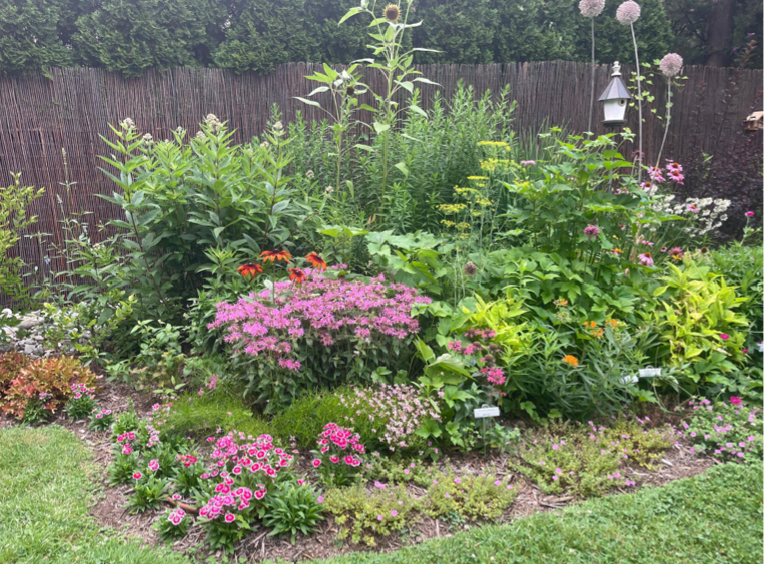
Karen Fricke’s pollinator garden in Caldwell, New Jersey. Photo by Melina Constantine
By Melina Constantine
Gardens are often thought of as carefully manicured spaces, the opposite of the wild landscapes they once replaced. But a growing movement known as rewilding is challenging that idea by encouraging homeowners to replace portions of traditional lawns with native plants that provide food and habitat for pollinators and other wildlife.
The movement comes amid broader concerns about habitat loss and declining biodiversity, including in developed landscapes. Originally associated with restoring large, natural landscapes, rewilding has increasingly found its way into suburban backyards, where the term is sometimes used more broadly to describe efforts to restore native plants and wildlife habitat.
In Caldwell, New Jersey, homeowner Karen Fricke has taken that approach to her own backyard. Her garden is designed to support pollinators and other wildlife while remaining an intentionally cultivated space.
When Fricke purchased her home four years ago, she began transforming her backyard into what she calls a hybrid garden, replacing much of the turfgrass with more than 70 species of native plants while leaving open lawn for her grandchildren to run and play.
"I wanted something that looked beautiful but also served a purpose," she said.
A certified Rutgers Cooperative Extension Master Gardener, Fricke doesn't use pesticides or herbicides and regularly removes invasive plants by hand. Fricke said the native plantings require less watering and fertilizer while providing habitat for pollinators and other wildlife.
This summer, Fricke opened her garden to the public in collaboration with the Native Plant Society of New Jersey, hoping to inspire others to incorporate native plants into their own yards.
What is Rewilding?
Traditionally, rewilding refers to restoring ecosystems and allowing natural processes to recover with minimal human intervention. In suburban settings, the term has also been used for efforts that restore native vegetation and wildlife habitats in yards and other developed spaces.
Native plants and shrubs are species that have evolved in a region over thousands of years and support relationships with local insects, birds, and other wildlife.
For many homeowners applying rewilding principles to their yards, the process doesn't mean eliminating lawns entirely. Instead, it can begin by replacing small sections of turfgrass with native flowers, shrubs, and trees that can gradually expand over time.
Why Replace the Lawn?
Fricke said that traditional lawns can provide a tidy aesthetic but relatively little ecological value. According to the University of Delaware, Americans use approximately 7.9 billion gallons of clean water each day on turfgrass landscapes. Fertilizers and pesticides applied to lawns can run off into waterways, where they can affect aquatic ecosystems and accumulate in marine and terrestrial animals.
The university also notes that traditional turfgrass lawns often function as monocultures—landscapes dominated by a single plant species—and, compared with landscapes containing a diversity of native plants, can offer fewer food and habitat resources for native insects and other wildlife.
Why Native Plants?
Some native plants are considered keystone species because they support a large number of other organisms within an ecosystem. In an interview with Fine Gardening magazine, University of Delaware entomologist and author Douglas Tallamy said just 14% of native plants in North America support approximately 90% of caterpillar species.
"Plants that support caterpillars [are] the two-by-fours in the ecological house we're building," he said. "They're essential. Your house will fall down without them."
Tallamy refers to many native plants as keystone plants because the caterpillars they support become food for birds and other animals higher up the food chain, serving as the foundation of a "functional food web." If native plants were removed from an ecosystem and replaced with nonnative species, there would be a "reduction of 88% of species of moths and butterflies in the country," said Tallamy.
Native plants can also require fewer resources once established, Fricke said. Because they are adapted to regional conditions, Fricke said she is able to maintain her native plantings with less irrigation, and without the use of pesticides or herbicides.
"After the first year, you shouldn't have to water them at all," Fricke said.
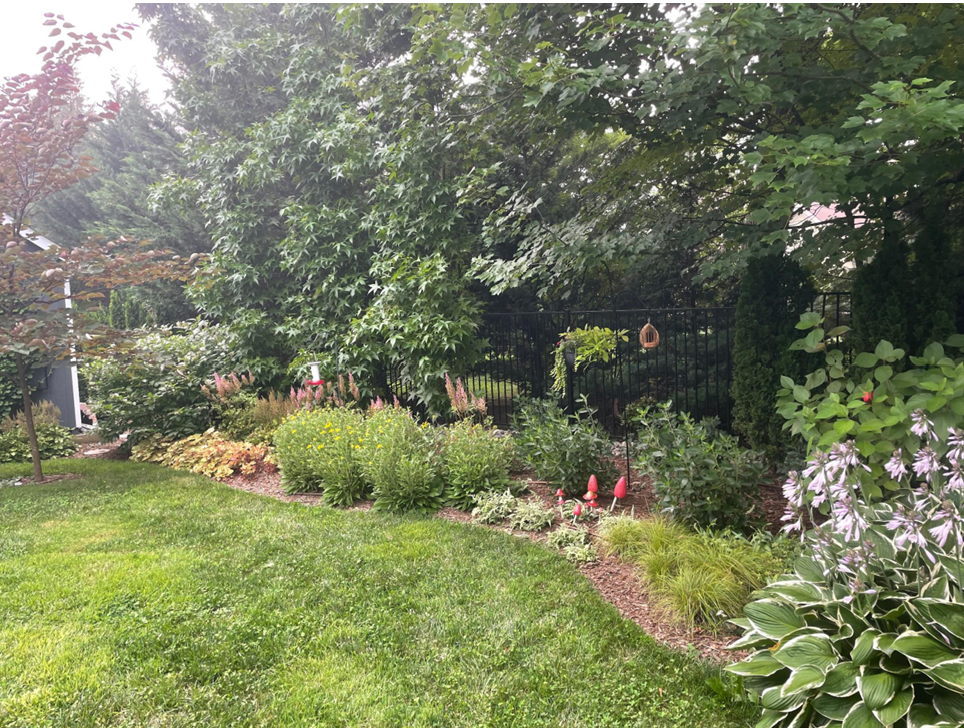
Native shrubs along the back fence in Fricke’s backyard. Photo by Melina Constantine
Native shrubs along the back fence in Fricke's backyard. Photo by Melina Constantine
How to Incorporate Native Plants Into Your Garden
For those who want to start a native garden but don't know where to begin, Fricke recommends starting with some simple research.
"The Native Plant Society of New Jersey has so much information about what shrubs are good, when they bloom, how much water they need, how much sun they need," she said. "You can really just map out your garden using that information."
She recommends avoiding invasive ornamentals commonly sold at large retailers and instead purchasing native species from local nurseries. She said despite their bright colors, some ornamental plants may provide less benefit to the insects and birds that rely on native species.
To make her remaining turfgrass even more pollinator-friendly, Fricke overseeds it with clover each fall. By spring, the clover produces white flowers that Fricke said provide an early food source for bees and other pollinators.
For beginning gardeners, Fricke recommends native echinacea. If the straight species—the naturally occurring form of the plant, rather than a cultivated variety—is unavailable, "Magnus" echinacea is "a good alternative," she said.
She also suggests Eastern bluestar, black-eyed Susan, ninebark, and milkweed, including butterfly weed and swamp milkweed, for monarch butterflies. To support swallowtail butterflies, she recommends planting dill alongside milkweed, since swallowtails can lay their eggs on dill and their caterpillars can feed on the leaves.
Her favorite late-season plants are New England aster and goldenrod, two native flowers that she values for their nectar production as late-season blooms.
For Fricke, building a native garden bed was the most important thing she did for her backyard.
"The plants have done really well," Fricke said. She now regularly sees hummingbirds, swallowtails, and bees visiting the flowers "all day long."
For more detailed guides that include step-by-step instructions and comprehensive plant lists, check out the resources linked below.
More Resources:
Doug Tallamy Website: Homegrown National Park
Less Lawn More Life Gardening Challenge
Melina Constantine is a rising senior at West Orange High School with an interest in political science, journalism and community involvement. She participated in CivicStory’s Summer Newsroom program to gain experience in research, interviewing, fact-checking and nonpartisan reporting