
From Backyard to Symposium: How One New Jersey Grower Put Her Soil to the Test
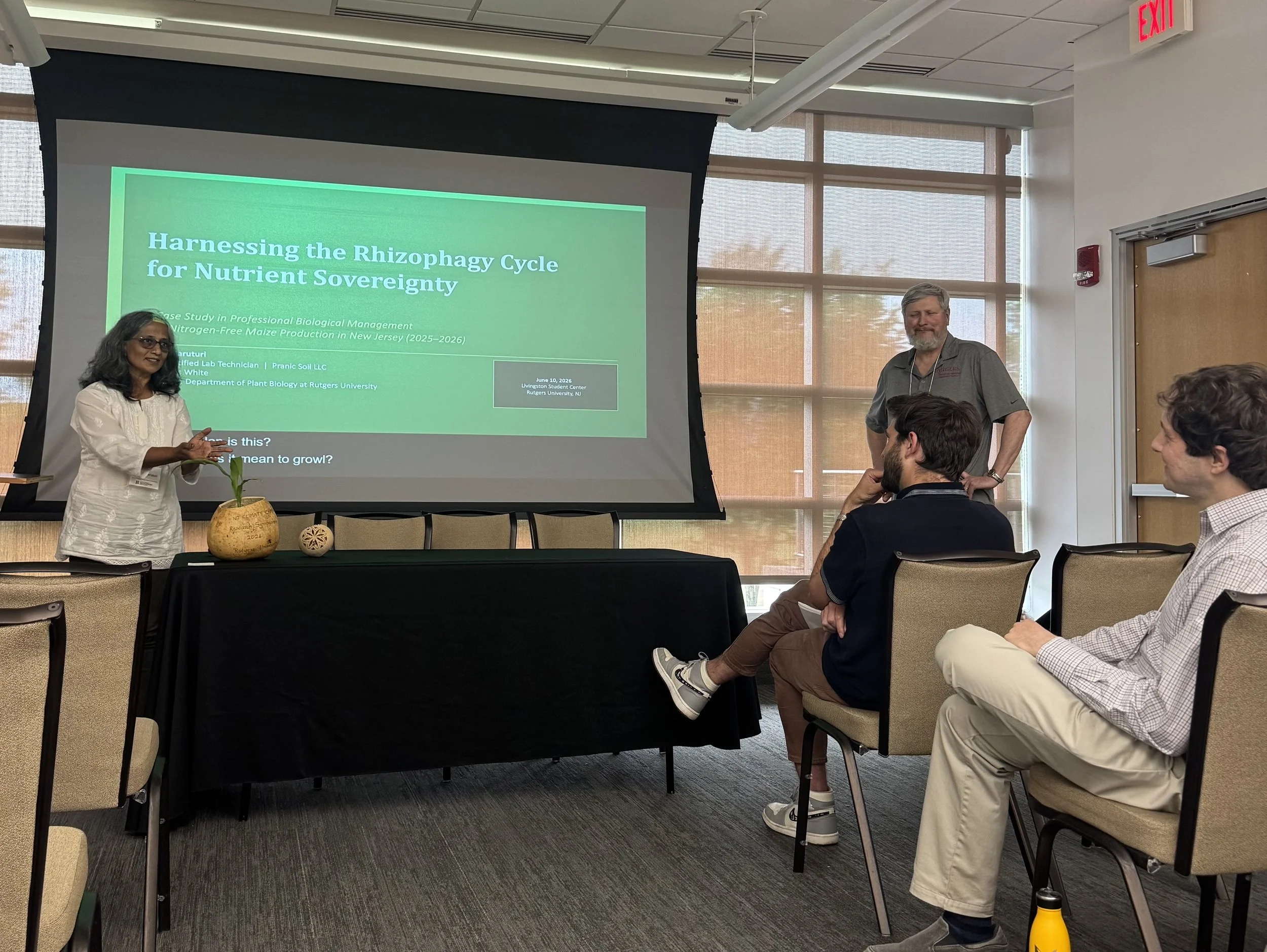
Photo by D’Arcy Perlman
One grower's experiment with living soil is reshaping the conversation about climate-resilient agriculture.
Story by D'Arcy Perlman
On a half-acre property in Monroe Township, Rajani Karuturi grows 125 species of plants. Part garden, part laboratory, the residential property has become a testing ground for an idea that could reshape how we think about agriculture, plant resilience, and the ground beneath our feet.
A certified Soil Food Web lab technician and founder of Pranic Soil LLC, Karuturi studies the living communities that distinguish barren dirt from fertile soils. With her at-home microscope, she examines the bacteria, fungi, protozoa, nematodes, and other microorganisms that drive nutrient cycling, store carbon, retain water, aerate the earth, filter pollutants and support plant health. While these organisms go largely unnoticed, Karuturi believes they are key to building more resilient food systems.
The growing interest in soil biology is not so much a new discovery as a new lens. Indigenous knowledge systems and generations of farmers have long understood that bountiful yields depend on healthy soil. What researchers are contributing is a deeper understanding of the biological mechanisms behind those observations, helping explain why practices that build “soil life” can improve plant health, resilience, and productivity.
Inspired by this emerging body of research, especially the work of Dr. James White, a professor of plant pathology and mycology at Rutgers University, Karuturi set out to test whether soil-centered growing practices could succeed in a home setting. That curiosity brought her to the stage of the 2026 Rutgers Climate Change Symposium on June 10, where she presented the results of a backyard field trial alongside White.
For more than a century, American industrialized agriculture has largely operated under a chemical paradigm: plants need nutrients, farmers supply those nutrients through chemical fertilizers, and crop production follows. Synthetic fertilizers produced through the Haber-Bosch process were designed to immediately increase agricultural yields worldwide, but they carry environmental costs and pose long term challenges. Over time, heavy reliance on synthetic inputs can damage the soil structure and diminish the biological activity that nutrients cycle naturally, increasing the need for continued intervention and worsening the levels of harmful nutrient runoff.
Yet healthy soils have supported plant growth for millennia without synthetic fertilizers.
The question, according to White, is what modern agriculture may have overlooked. "The old paradigm isn't correct," White said. "It's not all chemistry. The microbes are important."
White's research focuses on plant-microbe interactions and a process known as rhizophagy, a cycle in which plants attract beneficial microbes around their roots and absorb some of them into root tissues, where nutrients are consumed and remaining microbes are released back into the soil (rhizo: root; phagy: eating). The complex process boils down to a simple lesson: plants are not passive recipients of nutrients. They exist in constant partnership with the microbial communities that surround them.
To demonstrate the importance of these relationships, White and his colleagues have conducted experiments in which seeds and seedlings are sterilized and stripped of their microbes.
"If we remove the microbiology, plants just would not behave like plants," White said. Without their microbial partners, plants exhibit stunted development, reduced stress tolerance, and increased susceptibility to disease. For White, the findings point toward a larger conclusion: soil biology is not simply beneficial - it is essential.
Karuturi wanted to explore what that idea might look like outside the laboratory. Using challenging sandy coastal plain soils, she planted Ukrainian corn varieties known for their resilience under low-input farming systems. Rather than relying on synthetic fertilizers, pesticides, or seed treatments, she amended the soil with compost and rock powder and monitored biological activity throughout the growing season.
The results exceeded her expectations.
Karuturi grew corn to full grain maturity, producing fully developed ears with nutrient-dense, flavorful kernels and seeds that achieved more than 90% germination the following season. And what allowed this? Under Karuturi’s microscope she found bacteria, fungi, protozoa, nematodes, and other microarthropods flourishing in her soils. When she examined the roots she confirmed the presence of rhizophagy. A productive crop had grown on difficult soils at her own home with no synthetic fertilizer inputs.
However, for Karuturi, the project was about more than growing a successful crop. It was about demonstrating that local communities can play an active role in building what she calls "biosovereignty" - the ability to steward local food systems and natural resources through ecological knowledge rather than dependence on outside inputs.
Karuturi stated, “The value of the land should be based on how alive it is.” Biologically “alive” soils store carbon, improve water infiltration, reduce nutrient runoff, and support plants against drought and disease. As chemical fertilizer prices fluctuate and climate pressures intensify, practices that build soil biology may also help strengthen economic resilience for growers and their communities.
For homeowners and gardeners interested in supporting soil biology, White recommends adding compost and other microbially rich organic matter, keeping living roots in the soil through cover crops or year-round plantings, and increasing plant diversity. Rather than viewing plants as isolated organisms, White encourages growers to think of the soil as a living ecosystem. "People can experiment with it," White said. "That's what Rajani was doing."
The lesson that both Karuturi and White reiterate is that not everyone needs a laboratory or advanced scientific training. It is that healthy soils begin with supporting the microbial communities that plants have depended on for millions of years.
Karuturi's presentation reflected a broader principle, what she described as, “community-led peer-to-peer education”: Environmental resilience depends not only on scientific discovery, but on the willingness of communities to share observations and learn from one another. By sharing her results with both academic researchers and industry professionals, she hopes more growers will be empowered to test ideas, monitor, and contribute to a growing body of local ecological knowledge.
“Communities are better when members contribute,” added Kati Angarone, Chief Strategy Officer at the New Jersey Department of Environmental Protection and a Symposium panelist. “You’d be surprised at how many others agree and can add dimension to the kernel that was your idea.”
Karuturi's project demonstrates what can happen when that “kernel” is shared - transforming a question raised in a backyard garden into a conversation reaching researchers, growers, and communities across New Jersey.
D'Arcy Perlman is a plant biologist and UCLA graduate based in Maplewood, New Jersey, with research experience in ecology, conservation, and regenerative agriculture.