
Princeton’s Tiny Forest Taking Root, Providing Lessons
One year after volunteers planted 1,300 seedlings in Princeton, the community is learning what it really takes to grow a microforest.
By Davian Arroyo
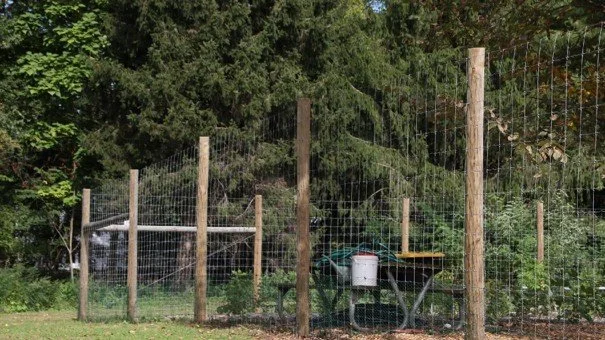
The fenced Quarry Park Microforest, where native trees and shrubs are taking root. Photo by Davian Arroyo.
When Inga Reich had first set about planning Princeton’s first miniforest, she knew there would be challenges ahead. Fences needed placing, the soil beneath needed amending, water sources piped in. There were lots of things she imagined might imperil this tiny pocket of green in a dense suburban community.
But Reich, who is the Open Space Manager for the municipality of Princeton, didn’t think her biggest problem would be a colony of rabbits.
Despite a protective fence, rabbits have chomped on many of the tree and shrub seedlings planted at the Princeton Microforest at Quarry Park a year ago.
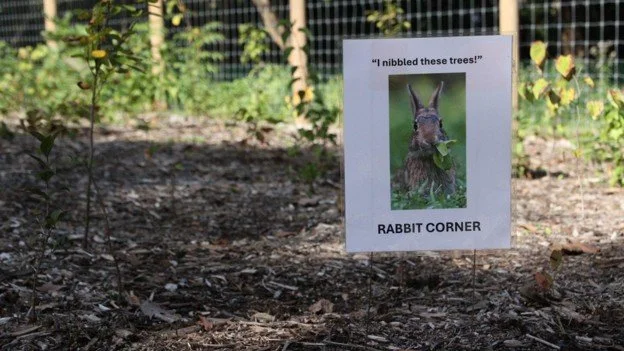
Watch out: trees and shrubs in this portion of the forest stand shorter than most. Rabbits are to blame. Photo by Davian Arroyo.
“These ones have just been repeatedly eaten and eaten,” she said, pointing out some saplings that looked like small sticks in the dirt. “I don’t know if they will recover. You can see it mostly along the edges, where the rabbits go in, nibble, and then move out again.”
CivicStory spoke to Reich at a sort of ‘birthday party’ for the project held on a recent Saturday, when volunteers returned to celebrate the microforest’s first anniversary. Armed with wheelbarrows, mulch, bulbs, and gardening tools, they got back to work caring for the small forest they helped create. And there’s plenty of work to do.
Reich, an ecologist, has spent the past year keeping a close eye on the microforest’s progress. She said much of the damage from the rabbits is concentrated along the perimeter, where they chomp off the tops and leaves of saplings.
Reich and her team put in additional chicken wire, but some of the damaged plants may not recover.
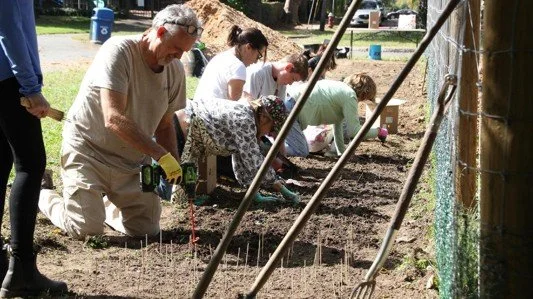
Volunteers planting bulbs alongside the young trees in the microforest. Photo by Davian Arroyo.
But rabbits aren’t the only challenge.
The soil is also posing problems. The site was originally full of overgrown grass and invasive weeds. The team used the “Scoop and Dump” method for soil remediation developed by Cornell University, mixing compost into the ground with a backhoe. This method is used specifically to help life thrive in urban environments, where the soil is compacted, lacking in microbial activity and deprived of nutrients.
Soil testing conducted two months ago revealed high alkalinity and low nitrogen levels in parts of the plot, making it difficult for certain plants to thrive. Species like highbush blueberry and hornbeam, which prefer more acidic soil, have struggled. Reich and her team added fertilizer containing nitrogen and sulfur to improve growing conditions for those shrubs and trees.
“That seems to have done a bit, so fingers crossed,” Reich told CivicStory.
Growing pains like this are normal, especially for the first year of a mini-forest’s life.
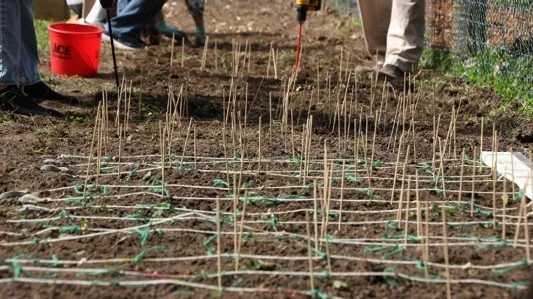
Young bulbs and wire mesh inside the Quarry Park Microforest. Photo by Davian Arroyo.
Princeton’s microforest was planted according to the Miyawaki method, an increasingly popular approach to growing dense, diverse forests by planting native trees and shrubs extremely close together.
In October 2025, around 100 volunteers came together to plant 1,300 native seedlings in a 6,000-square-foot plot here.
Unlike traditional tree planting, this method brings many different species into a relatively small space. At Quarry Park, approximately 30 to 40 species were selected, ranging from tall canopy trees to smaller shrubs.
As they grow, the plants compete for sunlight and space, eventually creating the different layers found in a mature forest.
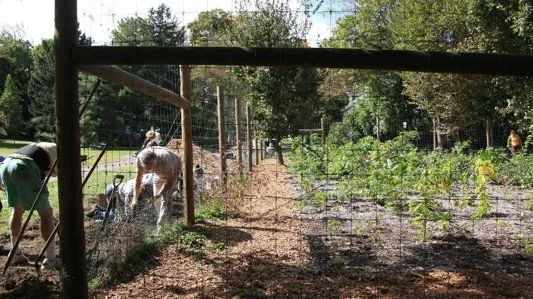
The planted microforest brings a variety of trees and shrubs into a compact, fenced space. Photo by Davian Arroyo.
The goal is to establish a healthy, self-sustaining forest in less time than it would typically take one to develop naturally. These pockets of green offer carbon capture, stormwater management, lower temperatures and high biodiversity.
The early years are crucial. Young trees are especially weak, and especially delicious to rabbits and deer. Coupled with difficult soil conditions, it is crucial the trees in Quarry Park are given time for their roots to become established, for their bark to harden.
Part of the ethos of the forest is to make it accessible to the community for enjoyment and educational purposes. But that takes time. Reich said that right now, the space is just too vulnerable to withstand foot traffic of any kind beyond those who tend to the forest’s basic maintenance. Right now, that mostly involves pulling weeds, watering, and adding mulch as needed.
The forest needs more time to strengthen up. By this time next year, Reich said she hopes the space can be opened up to neighbors, visitors and dog walkers.
The space mixes saplings of large canopy trees, smaller understory trees and shrubs and leaves them to battle it out for survival. So some may not make it to maturity. The smallest saplings within the plot face the largest risk of being dug up, eaten or trampled.
Eventually, the forest will be strong enough for the fence to be removed, giving more people a chance to walk through and enjoy this pocket of green space.
The anniversary brought together returning volunteers, new faces, and members of Princeton’s Shade Tree Commission and Environmental Commission. Volunteers of all ages gathered to plant bulbs along the exterior of the deer fencing, add mulch to the forest pathway and educate people passing by.
Reich provided cupcakes, and the community provided helping hands and listening ears. They spoke excitedly amongst themselves about the plot’s development, and as the day went on, the volunteer force got larger and larger.
One participant, Sonia Gessner, said the hands-on experience planting saplings made her feel connected to the place and gave her a lot of hope.
“So much of environmental work is just education and getting people involved, I feel like that starts with projects like this,” Gessner said. “It's really exciting.”
Gessner said she’s looking forward to seeing how the forest’s growth will unfold.
“With anything you plant, some things don't make it,” she said. “That is the way nature works. We often only think about what makes it.”
The gathering offered neighbors another opportunity to work and be together. Volunteers also said they felt a stronger connection to Quarry Park after helping plant and care for it. Some could even identify the exact saplings they planted a year earlier.
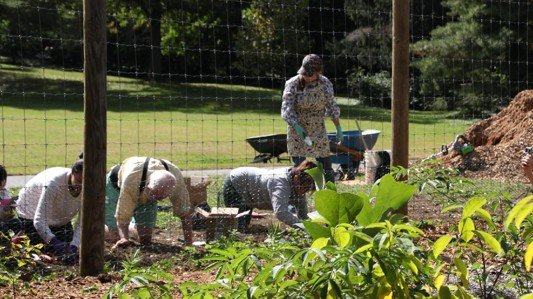
Volunteers work together inside the Quarry Park Microforest. Photo by Davian Arroyo.
A lot of groundwork went into getting this project going, including making sure there was community support and interest, said Anne Soos, chair of the Princeton Environmental Commission.
This project didn’t spring from the ground on its own; community meetings were held to make sure the project had buy-in and momentum. Chairs of environmental commissions, like Soos, wrote letters to editors. They publicized the forest proposal in local newspapers.
Generating interest not only ensured the forest would have a future, but gave volunteers a sense of being part of a larger community. Soos said that that sense of communal ownership is just as important as the work happening in the soil.
“I hope that it brings biodiversity and cooling and everything else,” Soos said. “But it's also just really important to make people feel they can make a difference.”
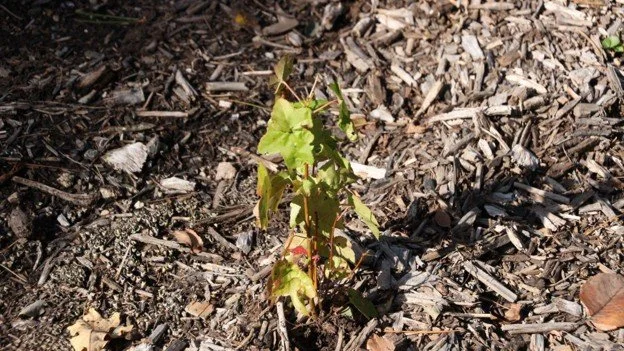
Giants come from humble beginnings. How large will this sapling be next year? Photo by Davian Arroyo.
Davian Arroyo is a Scripps-Howard fellow at CivicStory and a student at Drew University.