
Imagining the Wetlands’ Past and Future with Robert Sullivan
By Davian Arroyo
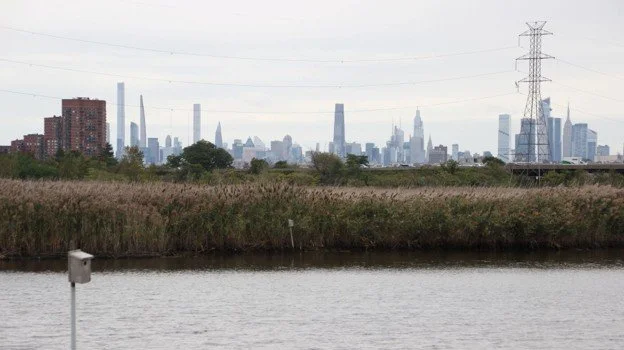
Photo by Davian Arroyo
I grew up in Newark and Bloomfield, but I’ve never thought much about the Meadowlands. To me, it was a stadium next to a garbage-strewn marsh, something you pass through on the train or the highway. For most of my childhood, what’s now the American Dream Mall was a construction site, a ghost of a project that seemed like it would never be completed.
One recent humid afternoon, I was driving down Route 3 when traffic came to a grinding halt. Still an hour or more from home, my car was stuck up against the bumper of the minivan in front of me. My eyes began to wander towards the green, out beyond the road margins. I thought, for a moment, about what might be out there in the tall grasses and marshes. I’m an avid hiker and I love the wilderness, but it didn’t occur to me to look for a way into the swampy expanses on the edge of the highway. I didn’t know there was anything of environmental or ecological importance there.
I turned off the highway for a moment and stopped on the side of Disposal Road and stretched my legs for a couple of moments. When the traffic started moving, I left.
Photo by Davian Arroyo
But something about that moment stuck with me. To understand more, I turned to “The Meadowlands: Wilderness Adventures on the Edge of a City” by author Robert Sullivan. He went to high school in Summit and took classes at Drew University, where I am a student, and he’s clocked many hours in the wilds of the Meadowlands.
Sullivan wrote the book back in 1998. It’s full of reverent and funny accounts of the mysterious and infamous, wild spaces that he spent years exploring on foot and by boat. It’s a sort of Hunter S. Thompson-style romp in this strange place and a look at the many proposals to develop and transform the area over the years.
Sullivan helped me understand why many of us see the Meadowlands as a wasteland. It’s as if we can’t see what’s just in front of us: A massive environmental and ecological resource.
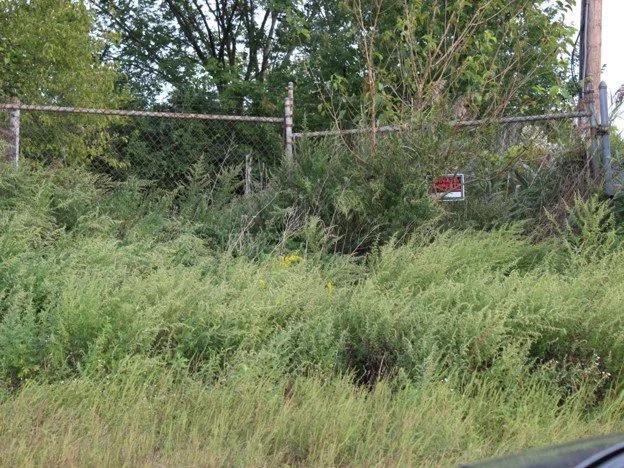
Photo by Davian Arroyo
“Even in our most polluting, dumpy moments, we humans are part of what we call nature,” he said. “So the creeks and marshes, despite being beat up, are still loved by people throughout all these years.”
The Meadowlands District is comparable in size to Manhattan. It runs through at least two counties and 14 towns. And this is part of its problem. It belongs to everyone and no one. Because it straddles so many communities, it’s overseen by a state agency that’s responsible for both its development and its preservation.
Sullivan describes the Meadowlands as ‘bowl-like’ in shape. The lifeblood that flows through this region is supplied through the Hackensack River and its tributaries, with the majority of marsh and wetland property at the center (or ‘bottom’) of the bowl. To him it spans beyond the boundaries drawn on maps, up into the streams and estuaries that connect to the marshes, from the Staten Island Kills to Englewood.
The area, Sullivan said, has been developed and dumped on for decades.
“They've dammed it and dyked it and tried to hold back the water and make it into Holland,” he said in a recent phone interview. “And so many of those giant ideas were thwarted by the place itself, the muddiness of it, the tides of it, the mess of it.”
With Sullivan’s book and words as a sort of guide, I headed to Richard W. DeKorte Park, home to the Meadowlands Environment Center and the Center for Environmental and Scientific Education. It’s part of the 190 acres of recreational land and eight miles of trails in the district that attract birders, hikers and cyclists. It was no simple journey to reach the Environment Center. I had to turn down Disposal Road, which once provided garbage-truck access to the Erie and Kingsland landfills; it’s a winding, pot-hole riddled street with warehouses on either side.
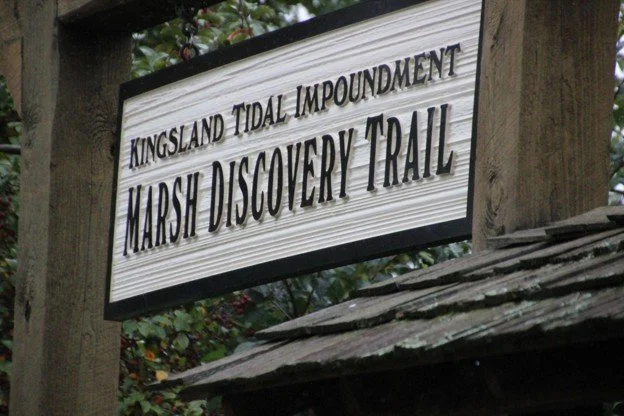
Photo by Davian Arroyo
So this place used to be a massive dump. It was closed in the 1980s and it took years for it to be remediated. You’d never guess this by looking at it now, though. I saw grass covered hills where the landfill once was. Old rusted chain link fences poke out like steel skeletons from the hills, which are otherwise almost entirely reclaimed by nature.
I looked towards this huge estuary that I had ignored for so long and let it pull me down winding gravel trails and walkways beside the water. Ospreys dove from overhead in search of prey, herons stood knee-deep in the murky marsh waters and a wind carried the smell of saltwater through the reeds and out towards civilization. By the Environment Center, a boardwalk area allows visitors to enjoy wildlife.
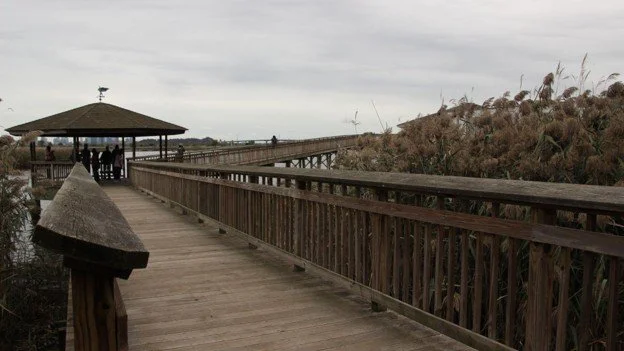
Photo by Davian Arroyo
Sullivan told me the Meadowlands were historically the ecological center of this region, back to the earliest human settlements here.
“They're alive,” he said of the marshes. “They produce more biological matter than anywhere else in the region.”
Indigenous people long harvested shellfish here. They saw it as a resource.
But starting as early as the 1700s, colonists saw the area as a problem, he said. The thick, untamed wetland environment has always made traversing the land difficult, while providing the perfect environment for concealing waste.
As New York City and its surrounding areas grew during the Industrial Revolution, the place became an early, chaotic industrial park full of factories and illegal dumping grounds. In the 20th century, Sullivan said, the environmental movement recognized that there was something worth saving and celebrating here.
“Suddenly people start to understand that the swamps and marshes that you dumped in and destroyed and thought were valueless, it turns out they're not valueless,” he said. “They have the greatest value in terms of ecology, but we don't associate dollar values with ecological values.”
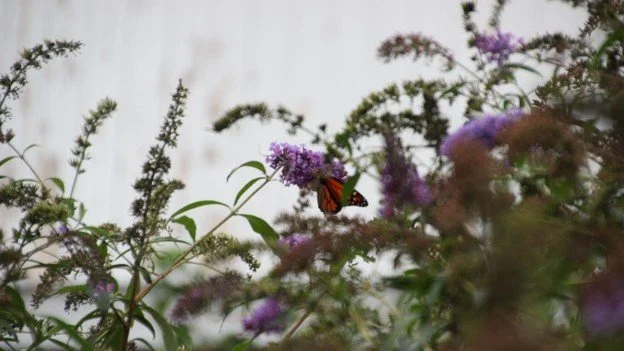
Photo by Davian Arroyo
And while there’s been tremendous progress in restoring these wetlands, it’s still the home of four superfund sites. Three of them are in Barry’s Creek, a tributary near Route 3, which takes drivers to the Lincoln Tunnel. One site, Walden Swamp, has an estimated 20 tons of mercury nestled within its soil as a result of heavy contamination going back as far as 1943.
And just before I visited the park, a data center in Secaucus spilled 5,000 tons of oil into Anderson Creek, a tributary of the Hackensack River. Sullivan said this push and pull, of development and preservation, pollution and restoration, is a dynamic that is always at play here.
“ There's this kind of yin and yang of the place as a problem and the place as a solution,” he said. “In a way the Meadowlands is a version of so many marshes and swamps and estuaries all over the world.”
To developers, the swamps themselves were seen as a problem in desperate need of a solution, as an unkempt source of disease. Filling them in and building on them was seen as progress.
As I walked on the gravel trail, I saw fields of phragmites, invasive grasses that grow in disturbed and stressed areas. Sullivan said they’re the scars of 19th and 20th century development, always threatening to take over the marshland.
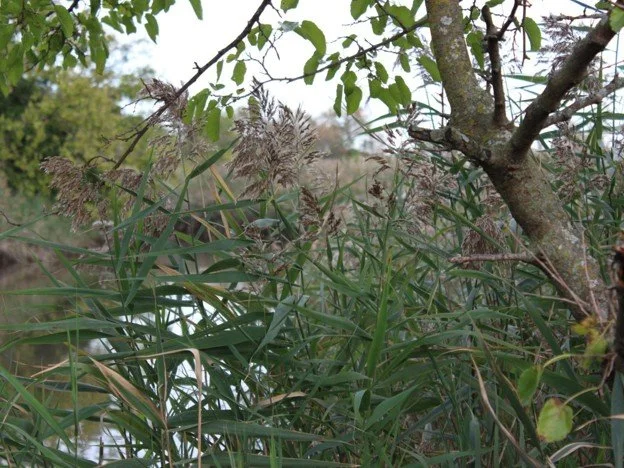
Photo by Davian Arroyo
Off the trail, through a patch of weeds and tall grass, there was what looked like a makeshift raft made of old driftwood and mismatched 2x4s tied together with twine. There was no trail, no way to have put that raft on the water without clear intent and purpose. It made me picture Robert Sullivan, hiking his way through and forging a path through the greenery, all in an attempt to get a better vantage point, some better angles and to tell a story that could not have been painted by sticking to the beaten path.
My walk in the Meadowlands made me feel small in the best way. I felt like a cog in this sprawling, ever-evolving machine, connected and inseparable from something bigger. The city on the horizon wouldn't have existed without the Meadowlands. The place has given us so much. The property hasn't always been taken care of or treated with the grace that it deserves.
Before my hike, I’d read Destination Meadowlands 2050, a new report by the conceptual design firm Regional Plan Association. It calls for reuniting the concrete Meadowlands (MetLife Stadium, Racetrack, American Dream Mall) with the namesake wetlands. The plan is a sort of hopeful, visionary blueprint for ecological restoration over decades. It calls for building roadways to make way for pedestrians and cyclists, returning underused parking lots to wetland and integrating trail networks into commercial areas so that one could go easily from a concert to a hike.
As it stands, the Meadowlands entertainment complex exists as a distinct and separate entity from its namesake wetlands. This plan would act as a bridge of sorts-—to make it so that you cannot visit the Meadowlands without running into the natural beauty of its creeks, marshes and swamps.
The Meadowlands, Sullivan told me, “has such a tortured history in terms of development and redevelopment and proposed development and re-proposed development and thwarted development and revived development.”
“ It's the ecological heart of the entire region,” Sullivan said. “This has always been the location for someone to make their great, weird dreams come true.”
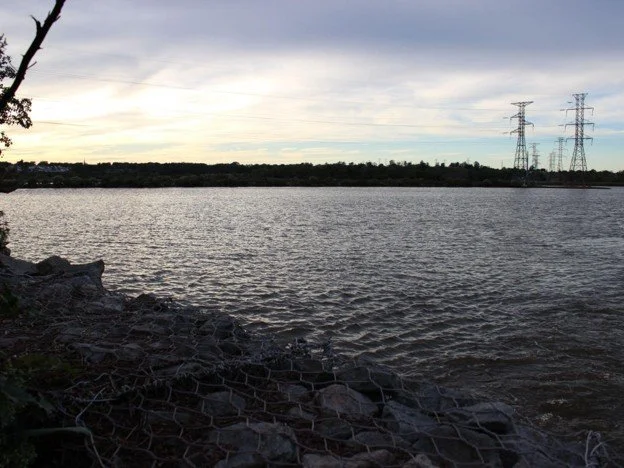
Photo by Davian Arroyo
Davian Arroyo is a Scripps-Howard fellow at CivicStory and a student at Drew University.