
Civics101: How Did America End Up With Two Major Political Parties?
Why It Matters Now
Have you ever wondered how the United States became the two-party system we know today? Despite common misconceptions, this structure is not mandated by law. While the Constitution establishes the framework for elections, it never once mentions a political party system.
With the primary election in New Jersey coming up on June 2, 2026, we’re breaking down the origins of American elections to help readers better understand the history behind their vote, from the Constitution’s design to the two-party system we participate in today.
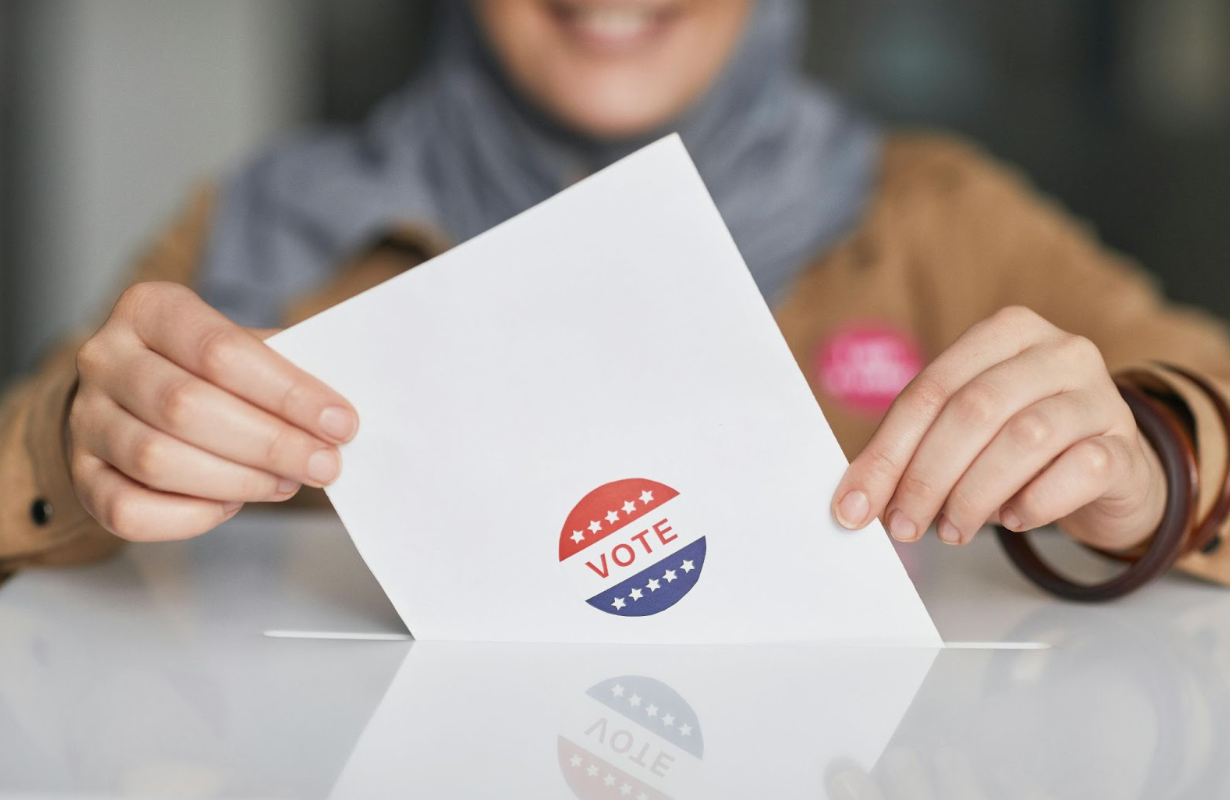
Primary elections allow political parties to select their candidates for the general election. Voting rules vary by state and the type of primary. Primaries play an important role in narrowing the field, either by reducing the number of candidates in a nonpartisan race or by selecting one candidate per party in a partisan race. It is important to vote in the primaries, since they determine who makes it onto the ballot. Local elections can be decided by just a few votes, so your participation carries more weight than you may think.
source: Pexels
“If voters in November are moderate but only have a choice between the progressive Democrat and the conservative Republican who won the primaries, the winner will be ideologically extreme,” said Laurel Harbridge-Yong, a professor of political science at Northwestern University.
A safe district is an electoral district where one political party consistently wins by a wide margin, leaving little real competition in the general election. Safe districts can result from practices like gerrymandering, where district lines are drawn to favor a particular political party by grouping together voters with similar political preferences. As a result, primaries often determine the eventual winner, giving more influence to primary voters than the general electorate.
“In the many safe districts and states, the primary election is the election that matters,” Harbridge-Yong said. She also noted that legislators often respond more to the preferences of primary voters than the general electorate. On issues where these groups disagree, this can lead elected officials to prioritize the interests of the few over the many.
A recent special election in New Jersey’s 11th Congressional District, previously represented by Mikie Sherill, reflects how these dynamics may be changing. In past elections, the ballot design favored party-backed candidates, who often dominated the polls. However, a federal court decision two years ago eliminated the “party line,” leveling the playing field for multiple candidates to compete more evenly.
“For a long time, the two parties dominated,” said Nicholas Chiaravalloti, a former member of the New Jersey Assembly. “You're now seeing a shift. That being said, there are still lots of challenges in voting in New Jersey if you're not a member of one of the two parties.”
Read the Learn Before You Vote section to better understand how party affiliation, ballot design and primary rules impact to learn how New Jersey’s primary system works and what steps to take to participate in the upcoming election.
For the upcoming primary election, you can vote by mail, go in early in person, or cast your ballot at a local polling site on election day. To learn more about each option, visit the New Jersey Voter Information Portal.
What The Constitution Actually Says About Elections
“The Times, Places and Manner of holding Elections for Senators and Representatives, shall be prescribed in each State by the Legislature thereof; but the Congress may at any time by Law make or alter such Regulations, except as to the Places of chusing Senators.”
Written in 1787, the above passage from Article I, Section 4, Clause 1 of the Constitution is often referred to as the ‘Elections Clause’, for it grants state legislatures the authority to set the times, place, and manner for federal elections, while also allowing Congress to modify those rules by law. Originally, Congress could not regulate the places where Senators were chosen, a power initially reserved for state legislatures, but the Seventeenth Amendment later established the direct election of Senators by popular vote, making that exception obsolete today.
The phrase ‘Times, Places and Manner’ has been interpreted to include rules about voter registration, voter protection, public notices, fraud protection, vote counting, and the certification of election results. While states are primarily responsible for establishing these procedures, Congress maintains the authority to create or modify federal election laws when necessary. However, neither states nor Congress can enact election laws that violate other constitutional protections.
The Constitution also sets specific qualifications for members of Congress, including age, citizenship, and residency requirements; states cannot impose additional requirements such as term limits on candidates seeking federal office.
Despite the authority given to state legislatures and the ultimate rule by Congress, it is important to remember that power still rests with the people. As noted in the Constitution, “No interpretation or change has ever been suggested that would take the final authority of our Government out of the hands of the people.” In other words, we, the people, are ultimately responsible for electing representatives to formulate laws, interpret them and enforce them.
Our representatives have the authority we grant them; they do not possess it inherently.
The Fourteenth Amendment, ratified after the Civil War in 1868, established further protections related to citizenship, civil rights, and equal protection under the law, clarifying who is entitled legal protections in the voting process. It also warned that states denying eligible citizens the right to vote could lose representation in Congress, reinforcing that political power depends on voter participation. When eligible citizens cannot vote, political power becomes less representative of the population as a whole.
The Constitution establishes the rules for how elections are conducted and who can participate in them, but it never defines how political competition itself should function. While it assumes elections will occur, it does not require or structure a party system.

source: Pexels
Political parties are a later development, not a constitutional design. According to Harbridge-Yong, structural features of the U.S. electoral system reinforce the dominance of two major parties.
“Single member districts and first-past-the-post voting [i.e., plurality voting], creates a two-party system,” Harbridge-Yong said. “Since winners only need to win a plurality [highest number of votes] in most states, third party voters have an incentive to vote for one of the two major parties, hopefully incentivizing that candidate to move toward their views.”
How The Two Political Parties Came to Be
The authors of the Constitution deliberately avoided mentioning political parties, aiming to prevent division or chaos in the new government. Founding fathers George Washington, Alexander Hamilton, and James Madison were all strong opponents of organized political factions, viewing them as a threat to national unity. Madison, who collaborated with Hamilton to defend the Constitution in the Federalist papers, argued in Federalist 10 that a “well-constructed Union” should help “break and control the violence of faction.”
Thomas Jefferson offered a contrasting perspective, arguing that it was a mistake to exclude political parties, even writing in 1824 that, “men by their constitutions are naturally divided into two parties.” Decades earlier, when Washington won the first presidential election in 1789, he chose Jefferson for his cabinet to ensure inclusion of differing political viewpoints, while also hoping to prevent potential opposition from him.
With Jerfferson as Secretary of State and Hamilton as Treasury Secretary, two visions for America emerged as the nation's first political parties. Hamilton’s Federalists, a majority of whom were Northern businessmen and merchants, favored a strong central government with ties to England. On the other hand, Jefferson’s Democratic-Republicans, consisting of small farmers, artisans and Southern planters, supported limited federal power and closer ties to France.
Though he had defended the Constitution with Hamilton, Madison opposed Hamilton’s financial programs and joined Jefferson in creating the Democratic-Republican Party in response to policies like assumption of state debts and the establishment of a national banking system.
By the mid 1790s, both Hamilton and Jefferson had left Washington's cabinet, and their disagreements had evolved into public clashes between the Federalists and Democratic-Republicans.
Washington warned in his 1796 Farewell Address that, “the common and continual mischiefs of the spirit of party are sufficient to make it the interest and duty of a wise people to discourage and restrain it.”
The election of 1796 reflected these divisions, as Federalist John Adams defeated Jefferson and tried to suppress opposition with the Sedition Act of 1798, which made it a crime to publicly criticize the president or his administration’s policies. However, Jefferson’s victory in 1800 allowed Democratic-Republicans to consolidate power and weaken the Federalist Party, which disappeared entirely after the War of 1812.
The two-party system eventually revived with Andrew Jackson’s Democrats and the Republican party.
The Democratic Party was founded in 1828, whereas the Republican Party was created in 1854. During the Civil War, Republicans opposed slavery, while Democrats largely supported it, particularly in the Southern states, holding Jefferson’s view of an agrarian society with limited federal power. After the war however, the Republican Party began to shift ideologies as wealthy northern industrials gained influence and deprioritized rights for Black Americans, believing they had done enough to transform the South.

source: Pexels
Over the following century, events like the Great Depression and the Civil Rights Movement shifted party support, resulting in Republicans becoming the more conservative party and Democrats assuming a more liberal label by the 1980s.
America’s two party system, as we know it today, was ultimately established despite the warnings and efforts by the Founding Fathers to prevent it.
“It was sort of the natural evolution that like-minded people would come together and call themselves something,” Chiaravalloti said. “The original Federalists under Hamilton or the original Democratic-Republicans led by Jefferson…followed this tradition of coming together as a community, sharing a set of values and campaigning on them.”
Learn Before You Vote
Here are a few concepts to master before the upcoming primary, so you can cast your vote more confidently:
Party Affiliation:
When you register to vote, you are not permanently bound to a specific political party, even if you do initially select one. Party affiliation can indicate which party’s primary you participate in, especially in the case of an open primary, but affiliation can usually be changed over time, in accordance with state-specific guidelines. Unaffiliated voters, sometimes labeled “independent,” refer to those who have not registered as a member of any political party.
Therefore, a party affiliation simply reflects which party you identify with for initial voting purposes; it does not limit you to voting for that party’s candidate in the general elections.Closed vs. Open Primary:
Primary elections are hosted to select candidates to represent each party in the general election.
- In a closed primary, only voters registered with that specific party can vote, meaning unaffiliated voters usually cannot participate.
-In an open primary, any registered voter may vote regardless of party affiliation, though they can only vote in one party’s primary during the same election cycle.
In New Jersey, the law provides for closed primaries, meaning voters must be registered with a party in order to vote in that party’s primary. Unaffiliated voters can declare a party affiliation on election day, but voters who are already affiliated and wish to change their party must do so by the 55th day before the primary.
Some states adopt a more hybrid approach, such as ‘partially closed’ where only unaffiliated voters can choose a party for the primary while already affiliated voters are restricted from crossing over, highlighting how primary voting rules can form more of a spectrum rather than follow a simple open/close divide. To learn about primary election rules in your state, visit National Conference of State Legislature’s state-specific guide.Ballot Design:
Ballots vary widely across the nation because election rules are set by a variety of state and local governments. While the Constitution and Congress do establish some guidelines, most elections are administered by states and counties, leading to differences in ballot presentation.
In New Jersey, state law requires primary ballots to group candidates by the office they are seeking in “office blocks,” meaning all candidates for the same position must appear together on the ballot, with consistent formatting. Visit the New Jersey Primary Election Ballot Design Guide for more details and visuals.Split-ticket Voting:
Split-ticket voting occurs when a voter chooses candidates from different political parties for different offices on the same ballot. Voters might be driven to do this if they are closely tracking individual candidates’ qualifications, policies, or character, rather than strictly following a party. At a larger scale, split-ticketing can actually encourage checks and balances by preventing one party from controlling multiple branches of government. This practice can influence election outcomes, sometimes creating divided governments and shifting campaigns toward candidate qualities instead of party loyalty.
Proportional vs Majoritarian Voting:
Electoral systems determine how votes transfer into seats.
-Majoritarian systems award seats to the candidate or party with the most votes, often leading to single-party governments. This might create a pathway for direct accountability, but sometimes serves to marginalize minority groups.
- Proportional representation allocates seats based on each party’s share of the vote, encouraging multi-party systems, providing fairer representation and greater inclusion.
Ideas for Reform
As concerns grow over whether the current electoral system reflects the broader electorate, proposed reforms aim to increase voter participation and representation.
Chiaravalloti pointed to expanding open primaries as one potential reform, which would allow unaffiliated voters to select party nominees without formally affiliating themselves with a party.
“Unaffiliated voters would be able to maintain their [status] and then vote either as a Democrat or Republican, depending on the candidate that they find most attractive,” Chiaravalloti said.
Another popular reform is ranked-choice voting, where voters rank candidates in order of preference and votes are reallocated until a majority (50 percent plus one) is reached.
In 2022, Alaska implemented the top four primary election where the top four most voted candidates advance to the general election regardless of party affiliation, and Ranked-Choice Voting for the general election, in which voters rank candidates in order of preference and a candidate must receive a majority to win, with additional rounds of counting until a majority is reached.
“If you really want a true representative democracy, you would continue to move away from this idea of party designation and have much more of an open primary process,” Chiaravalloti said.
Examining the roots of America’s two major political parties also offers insight into how election systems inform voter choice and participation in our democracy.